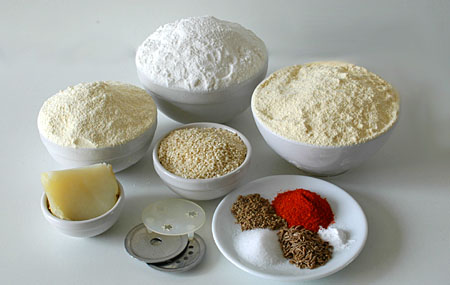
The vast majority of today's flour consumption is wheat flour.
Wheat varieties are typically known as, variously, "white" or "brown" if they have high gluten content, and "soft" or "weak flour" if gluten content is low. Hard flour, or "bread" flour, is high in gluten and so forms a certain toughness that holds its shape well once baked. Soft flour is comparatively low in gluten and so results in a finer texture. Soft flour is usually divided into cake flour, which is the lowest in gluten, and pastry flour, which has slightly more gluten than cake flour.
All-purpose or plain flour
This flour is a blended wheat flour with an intermediate gluten level which is marketed as an acceptable compromise for most household baking needs.
In terms of the parts of the grain (the grass seed) used in flour—the endosperm or starchy part, the germ or protein part, and the bran or fiber part—there are three general types of flour. White flour is made from the endosperm only. Whole grain flour is made from the entire grain including bran, endosperm, and germ. A germ flour is made from the endosperm and germ, excluding the bran.
Whole-wheat flour
This flour is whole-grain wheat flour.
Bleached flour
This is a flour that was subjected to flour bleaching agents for health purposes, to whiten it (freshly milled flour is yellowish), and to give it more gluten-producing potential. Oxidizing agents are usually employed, most commonly organic peroxides like acetone peroxide or benzoyl peroxide, nitrogen dioxide, or chlorine. A similar effect can be achieved by letting the flour slowly oxidize with oxygen in the air ("natural aging") for approximately 10 days; however, this process is more expensive due to the time required. [1]
Bromated flour
This is a flour with a maturing agent added. The agent's role is to help with developing gluten, a role similar to the flour bleaching agents. Bromate is usually used. Other choices are phosphates, ascorbic acid, and malted barley. Bromated flour has been banned in much of the world, but remains available in the United States.
Cake flour
This is a finely milled flour made from soft wheat. It has very low gluten content, making it suitable for soft-textured cakes and cookies. The higher gluten content of other flours would make the cakes tough.
Graham flour
This is a special type of whole-wheat flour. The endosperm is finely ground, as in white flour, while the bran and germ are coarsely ground. Graham flour is uncommon outside of the USA and the cities of Romania. It is the basis of true graham crackers. Many graham crackers on the market are actually imitation grahams because they do not contain graham flour or even whole-wheat flour.
Pastry flour or cookie flour or cracker flour
This flour has slightly higher gluten content than cake flour, but lower than all-purpose flour. It is suitable for fine, light-textured pastries.
Self-rising or self-raising flour
This is "white" wheat flour or wholemeal flour that is sold premixed with chemical leavening agents. It was invented by Henry Jones. It can also be substituted by Maida when cooking under the Indian Cuisine. Typical ratios are:
U.S. customary:
one cup flour
1 to 1½ teaspoon baking powder
a pinch to ½ teaspoon salt
Metric:
100 g flour
3 g baking powder
1 g or less salt
Durum flour
This flour is made of durum wheat. It has the highest protein content, and it is an important component of nearly all noodles and pastas. It is also commonly used to make Indian flatbreads.
Wheat flour is highly explosive when airborne. In medieval flour mills, candles, lamps, or other sources of fire were forbidden.
In Britain, many flours go by names different than those from America. Some American flours and British equivalents include:
Cake and pastry flour = soft flour
All-purpose flour = plain flour
Bread flour = strong flour, hard flour
Self-rising flour = self-raising flour
Whole-wheat flour = wholemeal flour


No comments:
Post a Comment